
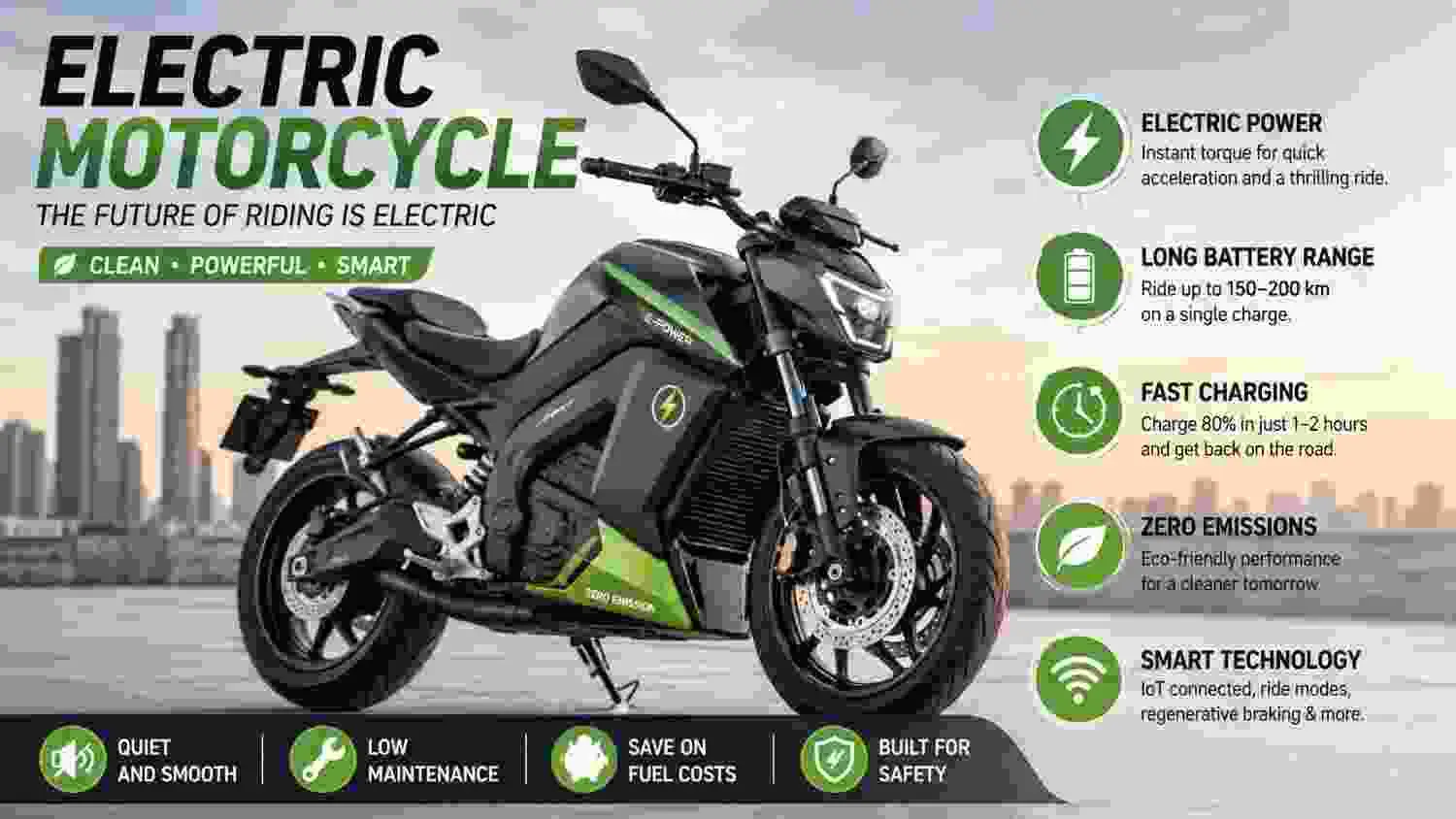
If you’ve ever sat behind a gas motorcycle at a red light and wondered why it needs to be so loud, you already understand the appeal of an electric motorcycle.
These bikes swap the engine, exhaust, and transmission for a battery pack and an electric motor, delivering instant torque with none of the vibration, fumes, or gear-shifting rituals of a traditional bike.
In 2026, electric motorcycles have moved well past the novelty stage , they now span everything from $2,000 commuter runabouts to six-figure hyperbikes that outrun combustion superbikes in a straight line. This guide explains how electric motorcycles work, what they’re genuinely good and bad at, what they cost, and how to decide if one fits your riding life.
What Is an Electric Motorcycle?
An electric motorcycle is a two-wheeled vehicle powered entirely by a battery pack and one or more electric motors instead of an internal combustion engine. There’s no gas tank, no exhaust pipe, and typically no clutch or gear shifter , twist the throttle and power arrives immediately, like flipping a switch rather than building revs.
Electric motorcycles range widely in size and purpose. Small electric mopeds and city commuters top out around 30-45 mph and are aimed at short urban trips. Mid-size street bikes compete directly with 300-600cc gas motorcycles in acceleration and daily usability. At the top end, performance electric motorcycles from brands like Energica, LiveWire, and Damon rival or beat superbikes in 0-60 mph times, while electric dirt bikes from Stark, Cake, and Sur-Ron have become genuinely competitive off-road machines.
Electric Motorcycle for Adults
Discover the best electric motorcycles for adults designed for comfortable, eco-friendly, and affordable daily transportation.
Learn about electric motorcycle features, battery range, charging time, top speed, performance, safety, and pricing.
Whether you need an electric motorcycle for commuting, city riding, or longer trips, this guide will help you choose the right model for your needs and budget.
Best Electric Motorcycle
Looking for the best electric motorcycle for adults? This guide explores top electric motorcycles for 2026, comparing range, top speed, battery capacity, charging time, performance, comfort, and price.
Popular choices include the Zero SR/F, LiveWire S2 Del Mar, and Can-Am Pulse.
The LiveWire S2 Del Mar offers up to 113 miles of city range and a 103 mph top speed, while the Can-Am Pulse reaches 80 mph and supports Level 2 charging from 20–80% in about 50 minutes.
Whether you need an electric motorcycle for daily commuting, city riding, long-distance travel, or high-performance riding, this guide can help you choose the right model for your budget and riding needs.
Electric Motorcycle for Kids.
Looking for a safe electric motorcycle for kids? Learn about child-friendly electric motorcycles, including important features such as age recommendations, speed limits, battery life, charging time, safety features, weight capacity, and parental controls.
This guide can help parents choose an age-appropriate electric ride for backyard fun, off-road riding, or supervised outdoor use.
Always check the manufacturer’s age and safety recommendations and provide proper protective gear.
Honda WN7 Electric Motorcycle
The Honda WN7 is Honda’s first full-size electric motorcycle, combining futuristic design with strong performance and fast charging.
The 2026 WN7 offers up to 50 kW of peak power, 100 Nm of torque, a 129 km/h top speed, and a certified range of up to 140 km. Its 9.3 kWh lithium-ion battery supports CCS2 fast charging, reaching 20–80% in about 30 minutes.
With Sport, Standard, Rain, and Econ riding modes, dual-channel ABS with IMU, a 5-inch TFT display, Honda RoadSync connectivity, and forward/reverse walking-speed assist, the WN7
Electric Motorcycle for Sale
Looking for an electric motorcycle for sale in 2026? Compare electric motorcycles based on price, battery type, range, motor power, top speed, charging time, and warranty before buying.
Whether you’re looking for an electric motorcycle for adults, a commuter bike, a long-range EV, or a powerful electric motorcycle, this guide can help you find the right model for your budget and daily riding needs.
How Does an Electric Motorcycle Work?
The basic system is simpler than a gas motorcycle, even though the underlying technology is more advanced.
The core components:
- Battery pack: Usually a lithium-ion pack, measured in kilowatt-hours (kWh), that stores the energy used to power the bike. Bigger packs mean more range but also more weight and cost.
- Electric motor: Converts stored electrical energy into mechanical motion. Most modern electric motorcycles use permanent magnet motors for their efficiency and compact size.
- Motor controller: Manages how much power flows from the battery to the motor based on throttle input, protecting the battery and motor from damage.
- Single-speed transmission: Most electric motorcycles skip a traditional multi-speed gearbox entirely, since electric motors produce strong torque across a wide rpm range.
- Regenerative braking: Many models recapture some energy during braking or deceleration and feed it back into the battery, slightly extending range and reducing brake wear.
Riding Experience
Because there’s no clutch and usually no gears, riding an electric motorcycle is closer to riding a bicycle with a very strong motor than a traditional motorcycle. Power delivery is linear and predictable rather than peaky, which many new riders find easier to manage , though experienced riders sometimes need a short adjustment period to get used to instant torque and the near-silent operation.
Key Features of Electric Motorcycles
- Instant torque: Full torque is available from a standstill, making acceleration feel immediate rather than building through a rev range.
- Single-speed operation: No clutch lever or gear shifter to manage in traffic.
- Regenerative braking: Recovers some energy and can reduce wear on friction brakes.
- Digital dashboards and app connectivity: Most modern models include a TFT display, ride modes (eco, sport, rain), GPS tracking, and smartphone apps for diagnostics and theft alerts.
- Removable or fixed battery packs: Some commuter models use swappable batteries you can charge indoors; larger bikes generally use a fixed pack charged through an onboard charger.
- Multiple ride modes: Adjustable throttle response, regen strength, and power output to suit different riding conditions.
Benefits of Electric Motorcycles
Lower running costs. Electricity is generally cheaper per mile than gasoline, and electric motorcycles eliminate oil changes, spark plugs, valve adjustments, and exhaust system maintenance, which lowers long-term upkeep.
Instant, smooth acceleration. Without gear changes, power delivery is continuous, which many riders find both fun and easier to control in stop-and-go traffic.
Quiet operation. Electric motorcycles produce far less noise than gas bikes, which is appreciated in residential neighborhoods and by riders who prefer a calmer ride.
Reduced local emissions. Electric motorcycles produce no tailpipe emissions, and depending on the local electricity grid, can meaningfully reduce a rider’s carbon footprint compared to a gas equivalent.
Home charging convenience. Many commuter and mid-size electric motorcycles can be charged from a standard wall outlet overnight, similar to charging a phone, removing the need for regular gas station stops.
Limitations and Disadvantages
Electric motorcycles are not the right choice for every rider, and it’s worth being honest about the trade-offs.
- Limited range on many models. Entry-level and mid-range electric motorcycles often deliver somewhere between 30 and 120 miles of real-world range per charge, which is less than a full tank on most gas bikes. Premium touring-oriented models close this gap but cost significantly more.
- Charging takes longer than refueling. Even with DC fast charging, a full charge typically takes anywhere from 30 minutes to several hours depending on the model and charger type, compared to a few minutes at a gas pump.
- Higher upfront cost at the performance end. While budget commuter models have become quite affordable, high-performance electric motorcycles still carry a price premium over comparable gas bikes.
- Charging infrastructure is uneven. Public charging stations suited to motorcycles are far less common than gas stations, particularly in rural areas.
- Battery degradation over time. Like any lithium-ion battery, motorcycle battery packs lose some capacity over years of use, though most manufacturers now offer multi-year battery warranties.
- Cold weather range loss. Battery performance and range typically drop in cold temperatures, similar to electric cars.
Electric Motorcycle vs. Gas Motorcycle
| Feature | Electric Motorcycle | Gas Motorcycle |
| Refueling | Charge at home or public charger (30 min–8 hrs) | Gas station fill-up (minutes) |
| Maintenance | Minimal , no oil changes, fewer moving parts | Regular oil, filter, and valve maintenance |
| Noise | Very quiet | Noticeably louder |
| Range | Typically shorter per “fill” on most models | Generally longer, especially on touring bikes |
| Running cost | Lower cost per mile in most regions | Higher fuel and maintenance costs |
| Upfront cost | Wide range; competitive at entry level, pricier at the high end | Wide range across all price points |
| Riding feel | Instant, linear torque, usually single-speed | Builds power through rpm and gears |
Neither option is universally “better” , the right choice depends on typical trip length, access to charging, budget, and what kind of riding experience you’re after.
Security and Privacy
Modern electric motorcycles are increasingly connected devices, and that comes with both benefits and considerations.
- GPS tracking and theft alerts: Many models include app-based tracking that can help recover a stolen bike, but this also means location data is being collected and stored by the manufacturer.
- Account security: Since the bike is often tied to a smartphone app account, using a strong, unique password and enabling two-factor authentication where available helps protect against unauthorized access to ride history or vehicle controls.
- Software updates: Some manufacturers push over-the-air software updates to improve performance or fix issues. Keeping firmware updated is important for both safety and security.
- Physical security: Because electric motorcycles are quieter, they can sometimes be pushed away by thieves without drawing attention the way a starting gas engine would. A physical lock or disc brake lock is still worth using alongside any app-based tracking.
No connected vehicle system should be considered completely secure, so treat the manufacturer’s app and account credentials with the same care you’d give any other connected device.
Performance, Range, and Compatibility
Real-world range depends heavily on riding style, speed, terrain, and temperature; manufacturer-quoted “city range” figures are typically higher than what you’ll see on highways, since higher speeds drain the battery faster.
General range tiers seen across the market in 2026:
- Entry-level commuters: roughly 20-60 miles per charge
- Mid-size street bikes: roughly 80-120 miles of city range
- Long-range touring and premium sport models: 150+ miles, with the largest battery packs pushing further
Charging speed also varies significantly. A standard wall outlet charge can take several hours, while models equipped with DC fast-charging hardware can add substantial range in 30-60 minutes at a compatible fast charger. Not every model supports fast charging out of the box , some require an optional charging accessory.
Compatibility considerations:
- Confirm whether your home electrical setup (standard outlet vs. higher-voltage circuit) matches the bike’s charging requirements.
- Check whether the manufacturer’s app works with your phone’s operating system.
- If you plan to use public chargers, verify the connector type is compatible with your bike, since standards can vary by region and manufacturer.
Cost and Pricing
Electric motorcycle pricing spans a very wide range, and the market has broadened significantly since the early days of the category.
- Budget commuter and mini electric motorcycles generally start in the low thousands of dollars, aimed at short-range city use.
- Mid-range street-legal models with more power, better range, and features like ABS and traction control typically land in the mid-to-high single-digit thousands.
- Premium performance and long-range touring electric motorcycles from established brands can run well into five figures, comparable to or higher than premium gas superbikes.
Beyond the purchase price, ongoing costs are generally lower than a gas motorcycle: no oil changes, fewer scheduled services, and electricity costs that are usually cheaper per mile than gasoline. Many manufacturers also offer multi-year battery warranties, which is worth checking carefully since the battery is the most expensive component to eventually replace. Always confirm current pricing directly with the manufacturer or dealer, since electric motorcycle prices and incentives change frequently.
Who Should Use an Electric Motorcycle?
- Daily commuters with a predictable, moderate-distance route and access to home charging
- City riders who want a quieter, low-maintenance bike for urban traffic
- Environmentally conscious riders looking to reduce tailpipe emissions
- Riders who value low running costs over years of ownership
- New riders who may appreciate the simpler, single-speed riding experience
Who Should Consider Alternatives?
- Long-distance touring riders who regularly travel beyond the practical range of current battery technology, especially in areas with limited charging infrastructure
- Riders without reliable access to charging, such as those in apartments without dedicated parking or outlets
- Budget-conscious buyers seeking the absolute lowest total cost, where a used gas motorcycle may still be cheaper upfront
- Riders in very cold climates who need consistent range through winter months without significant performance loss
Common Problems and Solutions
Problem: Range drops faster than expected. Solution: Aggressive throttle use, high speeds, cold weather, and hilly terrain all reduce range. Use eco or standard ride modes for longer trips and precondition the battery in cold weather when the bike supports it.
Problem: Charging takes longer than anticipated. Solution: Confirm whether your bike and charging location support DC fast charging. A standard wall outlet will always be slower than a Level 2 or DC fast charger.
Problem: App or connectivity issues. Solution: Keep the manufacturer’s app and the bike’s firmware updated, and check that your phone’s Bluetooth and location permissions are enabled correctly.
Problem: Reduced range after a few years of ownership. Solution: Some capacity loss is normal for lithium-ion batteries over time. Review the manufacturer’s battery warranty terms, and avoid regularly charging to 100% or letting the battery sit fully depleted for long periods, since both extremes can accelerate degradation.
Tips and Best Practices
- Charge to around 80-90% for daily use, and reserve full 100% charges for days you need maximum range.
- Avoid letting the battery sit at very low charge for extended periods.
- Use regenerative braking modes where available to extend range and reduce brake wear.
- Check tire pressure regularly, since electric motorcycles are often heavier than comparable gas bikes due to battery weight, which affects handling and tire wear.
- Review the manufacturer’s warranty terms for the battery specifically, not just the bike overall.
- If you’re new to electric motorcycles, test ride a few different models, since throttle response and regen braking feel can vary significantly between brands.
Frequently Asked Questions
What is an electric motorcycle?
An electric motorcycle is a motorcycle powered by a battery pack and electric motor instead of a gasoline engine, offering instant torque, quiet operation, and lower running costs.
How does an electric motorcycle work?
A battery stores energy that powers an electric motor, which drives the rear wheel, usually through a single-speed transmission rather than a traditional multi-gear system.
Is an electric motorcycle safe?
Electric motorcycles must meet the same road safety and certification standards as gas motorcycles in most markets. Riders should still wear proper safety gear and be aware that the near-silent operation means pedestrians and other drivers may not hear the bike approaching.
Is an electric motorcycle worth it?
For riders with predictable commutes and access to home charging, the lower running costs and reduced maintenance often make electric motorcycles worthwhile.
How much does an electric motorcycle cost?
Prices vary widely, from a few thousand dollars for entry-level commuter models to well over ten thousand dollars for premium performance and touring bikes. Always check current pricing with the manufacturer, since it changes frequently.
Do you need a motorcycle license for an electric motorcycle?
In most regions, any electric motorcycle capable of highway speeds requires the same motorcycle license or endorsement as a gas motorcycle. Smaller, low-speed models may fall under moped or scooter regulations, so check local vehicle classification rules.
How long do electric motorcycle batteries last?
Most manufacturers offer battery warranties covering several years, and modern lithium-ion packs are generally designed to retain a meaningful percentage of capacity after years of regular use, though this varies by brand and usage pattern.
How long does it take to charge an electric motorcycle?
This depends on the battery size and charger type , a standard wall outlet can take several hours for a full charge, while DC fast charging (where supported) can significantly reduce that time.
What are the disadvantages of an electric motorcycle?
The main trade-offs are typically shorter range than gas equivalents, longer refueling (charging) time, uneven public charging infrastructure, and a higher upfront cost for high-performance models.
Conclusion
An electric motorcycle isn’t simply a gas bike with the engine swapped out , it’s a genuinely different riding experience, built around instant torque, low noise, and reduced maintenance.
The category has matured considerably, with real options now available for city commuters, everyday street riders, off-road enthusiasts, and performance riders alike.
The right choice comes down to your typical riding distance, access to charging, and budget. If your rides are mostly short-to-moderate and you can charge at home, an electric motorcycle can lower your running costs and simplify ownership.
If you regularly cover long distances without reliable charging access, it’s worth comparing carefully against a gas motorcycle before deciding. Either way, test riding a few models is the best way to find out if the instant, silent acceleration of an electric motorcycle fits how you actually ride.

Shahid Imran is the founder of InfoPrimeX, where he writes about AI tools, technology, gadgets, apps, travel, and digital trends. His mission is to provide practical, easy-to-understand information that helps readers learn smarter, explore better, and stay ahead.
Website: infoprimex.com